
Simone Rocha Has Been Dressing for Her Adidas Collaboration Since She Was a Teenager

Simone Rocha has always been a world-builder. Since launching her eponymous label in 2010, the Irish designer has populated her particular universe with pearls and perspex, Catholic iconography and folkloric heroines, debutantes, dolls, and clothes both devotional and danger-inflected. But in crafting this evocative universe, for Rocha, has never meant sealing its borders. Collaboration has repeatedly offered a way to open up the oyster of Simone Rocha and unleash the pearls.
An early partnership with J. Brand saw her transpose the ruffles and saturated colors into denim, learning about washes and dyeing in the process. In 2024, she entered Jean Paul Gaultier’s archive as the house’s guest couturier, describing the experience to Vogue as a chance “to see what your spirit does in response.” And this June, another expansion: her first standalone menswear show, staged as Pitti Uomo’s guest designer in Florence, where she described it as “a new chapter in my work and world.”
The best collaborations, she tells Vogue from her east London studio, result in something that “either party couldn’t produce like the other.”
“I love to take people by surprise and be like, ‘Oh, I wasn’t expecting that, but of course I totally see that.’ That’s when I think something can feel magical,” Rocha says.
Which brings us to Adidas, and the beginning of a long-term partnership between Adidas Originals and Simone Rocha. The first collaboration was revealed at the designer’s fall 2026 show inside the cavernous, regal Alexandra Palace during London Fashion Week in February. The collection interweaved sensuous ideas: the ancient Gaelic story of eternal youth and romance in the mythological tale Tír na nÓg, with Perry Ogden’s 1999 photographic series Pony Kids, where youths from Dublin’s housing estates ride horses in a mix of equestrian gear and well-loved sports kits.
This was articulated in signature sporty Adidas silhouettes
This was articulated in signature sporty Adidas silhouettes transmutated through Rocha’s soft, feminine lens: lace-layered and ruffle-fronted track pants, diamanté and pearl-studded football socks, broderie anglaise draping bags. Faced with the considerably larger universe of the Three Stripes, Rocha found herself asking a characteristically specific question: “Adidas is just a big universe.
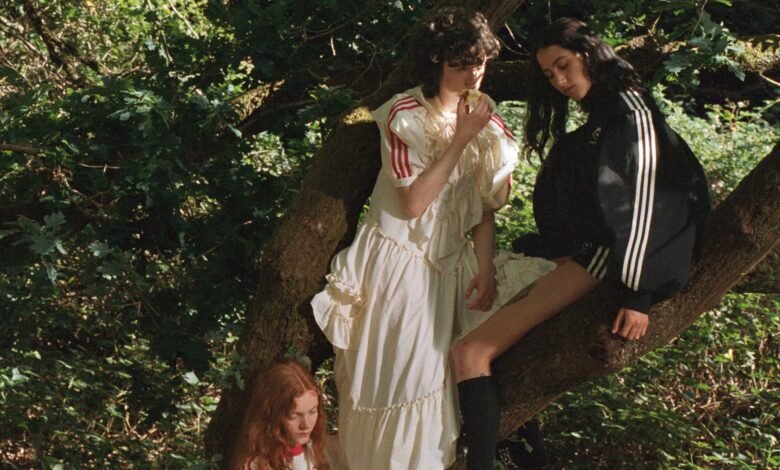
So I’m kind of like: ‘What is our planet?’” Here, exclusively on Vogue, the fuller picture unfurls: photographed by Justine Kurland in one dreamy tableau. The full collection will launch September 10 globally. As it turns out, Rocha had been dressing for that plane since she was a teenager. There are generations of Irish schoolgirls who know it well, too. “I used to wear Adidas under my school skirt,” the designer recalls.
Later, at college, the combination evolved into something much closer to the visual language she would eventually build a fashion house around: vintage petticoats and old tutus worn with Adidas Three Stripes football shorts underneath. “I had a red Firebird with black stripes that I loved,” she says. “I always appreciated how it grounded the femininity that came very naturally to the way I dressed.”
That is the central tension behind Adidas Originals x Simone Rocha: a partnership that threw the fashion world into a frenzy last February, but one that, for Rocha, has been hiding in plain sight for decades.
There is a cultural familiarity to it, too
There is a cultural familiarity to it, too. Growing up in the Republic of Ireland, Rocha saw sportswear entwined with a particular strain of young rebellion up and down the River Liffey. “It very much represents youth culture—boys and girls and the scene,” she says. “At home, you don’t want to be too dressed up. For me, it’s a big part of the culture, to almost feel like you’re kind of on the ground.”
The instinct to temper preciousness without sacrificing femininity is already fundamental to Rocha’s work.
With Adidas, it’s pushed. “For me, it was really bringing it into a feminine space, but from the point of view that feminine didn’t mean soft or fragile,” she explains. “It was about bringing this idea of strength, something very grounded and versatile, into this more feminine space.” Or, as she puts it elsewhere in our conversation: “It’s kind of like a hardcore femininity.”
The collaboration has been several years in the making, with serious conversations beginning around two years ago.
Rocha spent time working with the adidas team in Herzogenaurach, Germany, and digging through its vast archive of prototypes and memorabilia, where she became particularly fascinated by the functional origins of objects that have long since crossed over into fashion. “Everything has a point, everything has a reason,” she says. “Nearly everything comes from an athlete at some point in their career and a functionality that they needed in a trainer or in a sports bag.
It evolves into lifestyle
Then it evolves into lifestyle. They take their heritage very seriously, which I really admire.”
For this first chapter, she went straight to the Adidas canon: the Firebird, Superstar, Taekwondo, and Japan. The challenge was allowing both identities to remain legible. “The first collection needed to feel very, very signature to myself and Adidas,” she says. “How do I bring that into SR?” The answer came through proportion: swelling a sleeve, shifting a jacket’s cut, and using familiar Adidas fabrications in a palette that’s unmistakably Rocha.
The resulting collection turns the Firebird into a cropped, voluminous track top; balloons the sleeves of the Superstar; and transforms the Beckenbauer by introducing a tulle underlay beneath its familiar sporty shell. Elsewhere, frills caress pant hems, skirt hips, and dresses; fitted leotards act as second skins; and an Airline bag comes in broderie anglaise. A lace trim that appears traditional at first reveals tiny Trefoils engineered into its embroidery, and ribbon encircles the iconic Adidas motif to create a new collaborative badge.
Rocha even reconsidered the humble zipper pull, developing a detachable teardrop pearl—which is basically akin to her own logo—that can be removed when the clothes go into the washing machine. “I’m not a big logo brand,” she says, “and this is new for Adidas too.”
If there’s one piece that best captures the exercise, Rocha picks the Beckenbauer track top with its built-in tulle tutu.
It just really represents their world and my
“It just really represents their world and my world coming together,” she says. “That piece feels very iconic.”
Then there are the shoes. Three silhouettes—the SR Taekwondo Ballerina, SR Climacool, and SR Japan Fuzzy Slip On—take Adidas footwear somewhere considerably more coquettish. Ribbon laces and pearl-like embellishments cover the Taekwondo, while the technical Climacool becomes a Mary Jane, and the Japan is cut with a pony hair-effect upper and sculptural pearl-like Three Stripes.
“I’m obsessed with the Japan slip-on,” Rocha says. Footwear also provided one of the collaboration’s steepest learning curves. Making a trainer forced Rocha to consider a different kind of relationship between object and wearer, expanding ideas on performance wear. Across the collection, the same questions kept recurring. How does it feel on the body? What can somebody do in it?
Is a garment “a second skin,” or “an extra layer of protection?”
“You have to ask: what’s the reality of that material if it’s a trainer that someone has to wear every single day?” she says. Ironically, all that practicality hasn’t made her own collections more pragmatic. “Maybe, because I’ve done so much pragmatism with them, it’s made me want to make Simone Rocha almost more out of this world,” she laughs.
It’s pushed me in the other direction. There
“It’s pushed me in the other direction.”
There is an otherworldliness, too, to the campaign now being revealed alongside the collection. Rocha invited American photographer Justine Kurland, whose seminal Girl Pictures she has long admired, to photograph a cast of 11 young women, combining familiar Rocha faces with street casting. (We speak with Rocha’s expansive bookcase filled with Sarah Lucas compendiums and back issues of System magazine behind her—many liberated from her even larger collection at home.)
“I’ve always been very, very influenced by her work,” Rocha says of Kurland.
“We wanted to give this feeling of youth and realism, that they’re living in their own world. Her photos are a little bit displaced and a bit dystopian, so I liked the idea that it felt like its own world.” The photograph gathers the cast into a single scene, while an accompanying film moves between the individual girls and the wider collective. Now those clothes are about to leave the relative intimacy of a Simone Rocha runway and enter Adidas’s enormous global ecosystem.
“From Yohji Yamamoto to Raf Simons and Grace Wales Bonner: I’m really proud to be part of this fabulous roster,” she says. Adidas has long brought designers with fiercely individual identities into its orbit, and Rocha likes that “my space in that universe feels like its own little world.” She is curious, too, about the people for whom Adidas might provide a first encounter with her work.
I think it’ll be really interesting when
“I think it’ll be really interesting when it comes out,” she says, “because it may be a different crowd.”
And this world is only beginning to take shape. The fall 2026 collection marks the start of an ongoing partnership, leaving Rocha already thinking about where she might travel next: further into performance, perhaps, or into different sports and categories. We mull over the idea of dancewear, volleyball gear, or dressing an Olympics team in a few years time.
(All the while, fittings for her forthcoming spring 2027 collection continue outside the room.)
“There’s so much technique that has been untouched by me in their world,” she says. “That’s what I’m really excited about exploring.” But what seems to intrigue her most is sport as an emotional experience. “The emotion of watching sport, being around sport, the team feeling—it’s such an adrenaline, emotional, dopamine thing.” For a designer who has spent her career building worlds around the emotional possibilities of getting dressed, there is ever more terrain to claim.
Source: www.vogue.com